Gain core strength while maintaining a supple psoas by choosing to make pelvic integrity a priority. Too often what appears to be a weak psoas muscle is really an overused, misused and abused psoas due to pelvic disruptions. In an attempt to compensate for unstable pelvic sacral-iliac joints, the psoas ends up sore, tight and overworked. Most people do not have weak psoas muscles they have exhausted psoas muscles because this smart tissue is being relied upon for core support.
To balance your pelvis requires good positioning, the right idea and proprioceptive awareness. As Core Strength Trainer and Power Lifter Deric Stockton knows, centering the pelvis is not about core tension but developing core awareness: “A functional, proprioceptive, and responsive psoas” explains Deric, “enables you to sense L-spine (lumbar) neutrality while moving with bi-lateral equality through the hips/legs.” Power lifting over 700 pounds; Deric has achieved core strength while maintaining a supple psoas.
Pelvic Keystone
Gravity passes directly through the bony skeletal core via the spine, legs and feet; it does so by transferring weight from one spine to two legs through the pelvic basin. What creates and maintains pelvic integrity is a web of ligaments called the sacral iliac joints – this pelvic keystone transfers but does not bear weight. The psoas protects and attempts to prevent injury to the lumbar spine, pelvic keystone and nervous system. When torn, frozen or lax these proprioceptive rich pelvic ligaments communicate disturbed weight bearing signals that demand that the psoas, as messenger of the central nervous system, get involved. If weight does not move smoothly through the pelvis (evident by a torque, tipped or instable pelvic basin) it will be impossible to maintain a supple psoas.
The Box Squat encourages a somatic connection to the pelvic keystone by intentionally centering the pelvis while both standing and sitting. The Box Squat assists awareness in weight bearing activities by encouraging spinal, joint and psoas input via gravity and by revealing your natural spiral rotations – helping you somatically locate a centered core.
The Box Squat
Begin in front of a full-length mirror to help you visually organize your position and then once your bones are well aligned and the movement is flowing through both hips and feet evenly, close your eyes to deepen your internal cues and enhance proprioception (internal awareness).
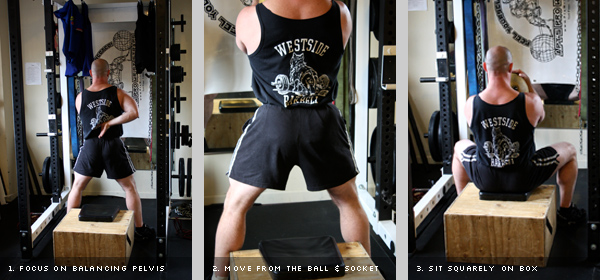
STEP 1: Use a simple wooden box – the higher the box the easier the exercise. Begin with a comfortable height so awareness, not stress, is the focus of your attention. Center your pelvis and align your feet wider then your hip sockets. Be sure both feet are even. Have the right ideas! Good positioning is the point of this exercise so take your time and be precise in your alignment.
STEP 2: Stand with legs wide apart with your weight balanced equally between both feet. Be bare footed or wear a light canvas shoe so you can feel the weight along the outside of both feet. Stand with legs straight, and arms at breastbone height straight out in front – one hand on top of the other. A variation is to hold a flat stone or medicine ball close to the chest. Head is up, eyes neutral.