
The One Muscle That Does Not Need Strengthening

Published by Liz Koch on August 15, 2005 in Articles

Located behind those flab or fab abs is a little known but oh so powerful muscle called your PSOAS (pronounced so-as). The only muscle to connect your spine to your leg, the psoas influences everything from low back pain and anxiety, to full body orgasms and pure pleasure. It is a supple, juicy dynamic muscle.

So why don’t people know about the psoas and why do so few physicians ever mention it?

Subtle to sense, the psoas is not easy to locate and because it is so deep within the human core, it can not easily be palpated (nor is it a good idea to have your psoas manipulated!).

A part of the flee/fight/freeze response, invasive techniques can exacerbate psoas problems. A primal messenger of the central nervous system the psoas is an emotional muscle expressing what is felt deep within the belly core – what is commonly referred to as “gut feelings”.

A tense psoas can disturb digestion, reproductive functioning and create a host of other aliments. Released and vital it fosters feelings of pleasure and comfortable.

Constructive rest is an easy position for releasing tension in your psoas muscle. After work and before your evening meal take 10 – 20 minutes to rest in constructive rest and feel the benefits.
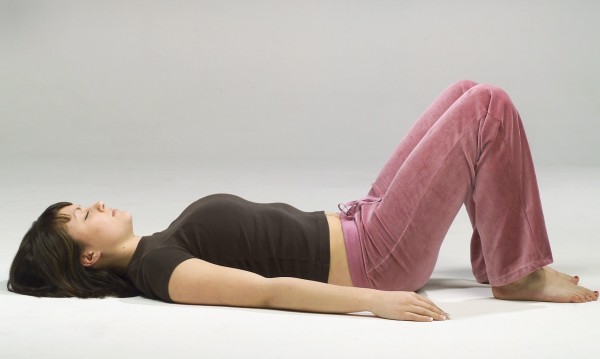
A safe and comfortable position, constructive rest helps to relieve back, pelvic and leg fatigue and tension. Begin by resting on your back. Knees bent and feet placed parallel to each other, the width apart of the front of your hip sockets. Place your heels approximately 12-16 inches away from your buttocks. Keep the trunk and head parallel with the floor. If not parallel place a folded, flat towel under your head. DO NOT push your lower back to the floor or tuck your pelvis under in an attempt to flatten the spine. For best results keep the arms below the shoulder height letting them rest over the ribcage, to the sides of your body or on your belly. There is nothing to do; constructive rest is a BEING position.

In this simple position gravity releases the psoas and you’ll feel more at peace with your self and the world.
Lydia Schultz
Posted on April 18th, 2007 | Permalink

Ok! I have accepted that I have a psoas problem. It leads to my SI joint going out also, I believe. I have been doing yoga, rolfing, walking, I have a sacro wedgy and sit on a golf ball. I will do ANYTHING. The pain is so intense sometimes that I am at the end of my rope and often wonder sometimes how I can live like this.

I need to know if there is an end to this problem! I need to know if there is some way that I will be permanently relieved. I was told a couple times that because of a TOTAL hysterectomy that SCAR TISSUE could be a problem. Is this a possibility?

My pain? Lower back always. Glut on the right side. Top of the thigh. GROIN! omg! Groin is an issue particularly in yoga. Lateral movement of the thigh is a no no! Big time. Shooting pains go into the knee and sometimes actually even in the thigh. All of this is on the right side. Sleeping is sometimes interrupted.

PLEASE tell me what I can do, where I can go, and that it will be resolved. Yes.

Lydia Schultz

Susie Pollitt
Posted on July 3rd, 2007 | Permalink

I am a trained body worker (though I have not worked since giving birth, and cannot work ‘cos of lower back problems) and yet I am almost ashamed to admit that I did not know this. Yet I thought the training I had received was excellent!I did do this posture on a regular basis for 20 mins at a time – no wonder it helped to keep me functioning at the time! Thanks

doug farley
Posted on January 3rd, 2008 | Permalink

i have been working on my psoas muscle for 1 year i was interruppted last may when i had a near fatal dissection to my aorta (tripleA) i am again working on my stretches. the surgern told me that my aorta is damaged in my right lower limb. i have always had pain there of which i thought as of 1 year ago it was my psoas….is there a connection. it seems like doctors are not paying much attention to psoas. thanks in advance
doug

The Velvet Workout « Vermont Pilates
Posted on March 2nd, 2010 | Permalink

[...] might wonder how I relaxed that very deep muscle in the core. I did it by doing the Constructive Rest Position. Doing the CRP allows the psoas a bit of a break from it’s over working day. I equate an exhausted [...]

Liz Koch
Posted on March 28th, 2010 | Permalink

A relaxed supple psoas is a great starting place…..


leave your comment